Rotary Park
Posted by Roseanne Morissette
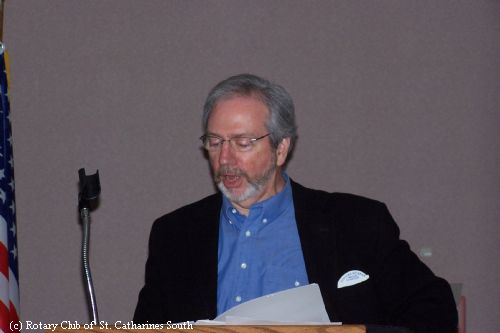
"The Rotary Civic Affairs Committee has a very positive vision for the future development of Rotary Park." - Michael Michaud
Rotarian Jim Shannon, a member of the Rotary Civic Affairs Committee, introduced Mr. Michael Michaud, Guest Speaker, who updated the club on Rotary Park.
Mr. Michaud was born in Thorold-Niagara. He left the area and returned in 1980 at the age of 37. Michael is a third-generation papermaker. His grandfather worked at Ontario Paper Company. His father worked at Domtar in St. Catharines. Michael started working in the paper mills as a 16-year-old student. Michael attended St. Francis Xavier University and Nova Scotia Technical University and obtained his Bachelor of Mechanical Engineering degree in 1966. He joined Reed Paper Company in Quebec City and held several professional and management positions until 1980. In 1980, Michael joined Ontario Paper Company and was Engineering Manager for the construction of the Company's new Mill in Thorold. He was made Director of Corporate Planning at the company's corporate office at Corbloc. In 1984, Michael was promoted to Vice-President of Engineering and Research. He held this position until the company was sold in 1996. Michael served on the Executive and Board of the United Way for five years, on the Board of Trustees of the Hotel Dieu Hospital for five years, and has been a Rotarian for six years. He is currently Chair of the Civic Affairs Committee and on the Board. He is also active in his church, St. Alfred's. Michael is married to Diane, and they have three children - all Queen's University graduates - and one grandchild.
Rotary Park is a 32-arce parcel of land on the south side of Pelham Road, opposite the Decew Hydro Generating Station and overlooking 12-Mile Creek.
In 1988, the Rotary Club of St. Catharines South joined with the Downtown St. Catharines Club in co-sponsoring Rotary Park.
For environmental reasons, Rotary Park soon fell into disuse and very limited use. Officially, the park is not open to the public.
In 2005, the Civic Affairs Committee began making enquiries and meeting with City and Parks officials as well as City elected officials. The Committee feels strongly that current environmental problems will be solved. More importantly, they feel there are tremendous future opportunities in the 12-Mile Creek Greenbelt, which must not be overlooked:
1. There is a need for the Park in this area.
2. The needs or mandate of the Park have changed as it also serves as a major gateway to a green belt and trail system along the 12 Mile Creek.
3. The problems that beset the Park are going to have to be rectified for environmental reasons.
4. A June 2007 Re-Opening of Rotary Park is recommended.
An overall concept has been developed around three very distinct attributes of this park:
1. the unique and spectacular views afforded from the east edge of the park.
2. the proximity of this park to exiting trail systems and to a very strategic and as of yet undeveloped 12 Mile Creek greenbelt.
3. the need to resurrect the involvement of the local Rotary clubs including the rejuvenation of the Rotary wheel garden and tree planting park.
It has been determined that a park of passive usage is in greater need than a traditional local park and playground area. The major highlight of the park will be two observation platforms at opposing ends of the east edge of the ravine complete with instructional signage.
The natural component will consist of inter-connected areas within the park, each showcasing a different ecological system such as grassland or forest. These areas will be planted with native flora indigenous to the area and complimentary to the diminishing Carolinian forests. They will also be tied into existing natural areas bordering the park.
Complimentary areas of clipped grass and shade trees will be created for more intense passive uses, such as picknicking, playing catch, etc. The trees of this area will incorporate and resurrect the tree planting park concept and will radiate out from the formal Rotary wheel garden and parking area at the west edge of the park.
All of these areas will be tied together with the provision of a wheelchair accessible internal trail system connecting the various points of interest within the park. These trails will also provide hiker access to external trail systems. Signage will be added to welcome, direct, inform, and instruct visitors of the attributes of the park and near by points of interest.
The combination of the proposed park attributes and comprehensive signage will provide a very unique educational experience especially considering the unique views and areas of historical significance within and adjacent to the park. The committee envisions public schools making annual field trips to the park.
Niagara's growth opportunities include service-oriented businesses, healthcare, hospitality and tourism, agri-tourism, eco-tourism, and higher education. Rotary Park fits in well with this new Niagara. And the partnership between local Rotary Clubs and the City of St. Catharines will set an important precedence for the growth of St. Catharines.
Michael and his associates on the Civic Affairs Committee were thanked for making their presentation to the Rotary Club of St. Catharines South.
Mr. Michaud was born in Thorold-Niagara. He left the area and returned in 1980 at the age of 37. Michael is a third-generation papermaker. His grandfather worked at Ontario Paper Company. His father worked at Domtar in St. Catharines. Michael started working in the paper mills as a 16-year-old student. Michael attended St. Francis Xavier University and Nova Scotia Technical University and obtained his Bachelor of Mechanical Engineering degree in 1966. He joined Reed Paper Company in Quebec City and held several professional and management positions until 1980. In 1980, Michael joined Ontario Paper Company and was Engineering Manager for the construction of the Company's new Mill in Thorold. He was made Director of Corporate Planning at the company's corporate office at Corbloc. In 1984, Michael was promoted to Vice-President of Engineering and Research. He held this position until the company was sold in 1996. Michael served on the Executive and Board of the United Way for five years, on the Board of Trustees of the Hotel Dieu Hospital for five years, and has been a Rotarian for six years. He is currently Chair of the Civic Affairs Committee and on the Board. He is also active in his church, St. Alfred's. Michael is married to Diane, and they have three children - all Queen's University graduates - and one grandchild.
Rotary Park is a 32-arce parcel of land on the south side of Pelham Road, opposite the Decew Hydro Generating Station and overlooking 12-Mile Creek.
In 1988, the Rotary Club of St. Catharines South joined with the Downtown St. Catharines Club in co-sponsoring Rotary Park.
For environmental reasons, Rotary Park soon fell into disuse and very limited use. Officially, the park is not open to the public.
In 2005, the Civic Affairs Committee began making enquiries and meeting with City and Parks officials as well as City elected officials. The Committee feels strongly that current environmental problems will be solved. More importantly, they feel there are tremendous future opportunities in the 12-Mile Creek Greenbelt, which must not be overlooked:
1. There is a need for the Park in this area.
2. The needs or mandate of the Park have changed as it also serves as a major gateway to a green belt and trail system along the 12 Mile Creek.
3. The problems that beset the Park are going to have to be rectified for environmental reasons.
4. A June 2007 Re-Opening of Rotary Park is recommended.
An overall concept has been developed around three very distinct attributes of this park:
1. the unique and spectacular views afforded from the east edge of the park.
2. the proximity of this park to exiting trail systems and to a very strategic and as of yet undeveloped 12 Mile Creek greenbelt.
3. the need to resurrect the involvement of the local Rotary clubs including the rejuvenation of the Rotary wheel garden and tree planting park.
It has been determined that a park of passive usage is in greater need than a traditional local park and playground area. The major highlight of the park will be two observation platforms at opposing ends of the east edge of the ravine complete with instructional signage.
The natural component will consist of inter-connected areas within the park, each showcasing a different ecological system such as grassland or forest. These areas will be planted with native flora indigenous to the area and complimentary to the diminishing Carolinian forests. They will also be tied into existing natural areas bordering the park.
Complimentary areas of clipped grass and shade trees will be created for more intense passive uses, such as picknicking, playing catch, etc. The trees of this area will incorporate and resurrect the tree planting park concept and will radiate out from the formal Rotary wheel garden and parking area at the west edge of the park.
All of these areas will be tied together with the provision of a wheelchair accessible internal trail system connecting the various points of interest within the park. These trails will also provide hiker access to external trail systems. Signage will be added to welcome, direct, inform, and instruct visitors of the attributes of the park and near by points of interest.
The combination of the proposed park attributes and comprehensive signage will provide a very unique educational experience especially considering the unique views and areas of historical significance within and adjacent to the park. The committee envisions public schools making annual field trips to the park.
Niagara's growth opportunities include service-oriented businesses, healthcare, hospitality and tourism, agri-tourism, eco-tourism, and higher education. Rotary Park fits in well with this new Niagara. And the partnership between local Rotary Clubs and the City of St. Catharines will set an important precedence for the growth of St. Catharines.
Michael and his associates on the Civic Affairs Committee were thanked for making their presentation to the Rotary Club of St. Catharines South.