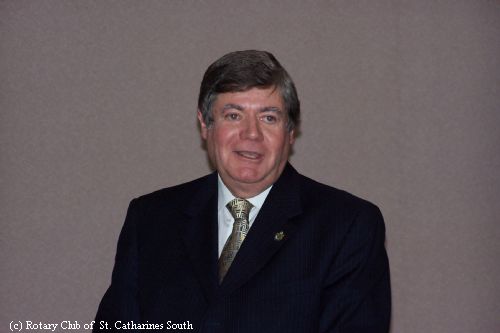
"The Niagara Region, working with other levels of government and with committed community leaders like the Rotary Club of St. Catharines South, is on the path to making Niagara an even better place to live."  - Peter Partington, Regional Chair, Regional Municipality of Niagara.   
 
Rob Welch introduced Guest Speaker, Mr. Peter Partington, Regional Chair, Regional Municipality of Niagara.

A native of St. Catharines, Mr. Partington completed secondary school at St. Catharines Collegiate and went on to study at the University of Western Ontario where he obtained his B.A. and L.L.B. He was called to the Bar in 1965 and was appointed Queen's Counsel in 1976. He practiced law until March 2004.


Mr. Partington served his community in the role of MPP for the riding of St. Catharines-Brock from 1985-1987.


Prior to being elected Regional Chair in November 2003, Mr. Partington was a member of Niagara Regional Council for St. Catharines from 1994 and served as Chair of the Corporate and Financial Services Committee and Chair of the Ad Hoc Committee on the Review of Municipal Services.


From 1999-2000, Mr. Partington was Director of the Association of Municipalities of Ontario, and from 2000-2003, he served as Director and President of the Ontario Great Lakes Foundation.


Mr. Partington is married to Betsy and has two sons, Peter and Robert.


Good afternoon, Rotarians.  It is a pleasure to be with you, and I offer greetings on behalf of Niagara Regional Council.


Niagara is a truly blessed community.  We are the custodians of a magnificent cultural, historical, and natural heritage that would be the envy of anyone in the world.  However, with such blessings come unique challenges and opportunities which we must deal with as a community.  Our border crossings, economic development, and taxation are all issues of importance to Niagara today.


BORDER ISSUES


Many of us enjoy going to Buffalo to take in a Sabres or a Bills game.  Indeed, our close proximity to the border and our close relationship with our Western New York neighbours has created an atmosphere in which many of us cross the border without much more thought than what we would give to crossing the Garden City Skyway Bridge.  Indeed, many of our visitors come to Niagara the same way. 


On average, we host 14 million visitors per year, and in 2004 over 12.5 million cars used our border crossings.  This makes Niagara the largest Canada-US passenger crossing. Further, over 2.3 million trucks on average used our Niagara crossings making Niagara the second largest truck crossing border between Canada and the United States (Windsor-Detroit is #1 with just over 3 million trucks per year).  We are indeed a vital link between the dynamic economies of southern Ontario and the eastern United States; and it is vitally important that this link functions as effectively and efficiently as possible.


That is why I brought this issue forward in my meeting with Deputy Prime Minister Anne McLellan during a recent mission to Ottawa. 


In 2004, the Ministry of Public Safety and Emergency Preparedness - Minister McLellan's portfolio - and the Department of Homeland Security of the United States struck a deal instituting a challenge to shorten border transit times at the Detroit-Windsor crossings by 25% over the previous year.  In order to achieve the goal set by the 25% Challenge, the Canada Border Security Agency undertook an initiative to hire 30 new inspection officers for that crossing.


I encouraged Minister McLellan to extend this challenge to the Niagara border crossing.  Minister McLellan agreed to institute the program here as soon as possible. 


Although we are thankful for the border infrastructure improvements the federal government have undertaken over the past couple of years, inspection booths at our border crossing are not sufficiently staffed.  It's important for us to have new inspection booths, but without people to operate them they must remain closed.  That is why we need the 25% Challenge in Niagara.  We need personnel in those booths to ensure that our border operates as effectively as possible.


We also need the Federal Government to put an end to the Wild Cat strikes that have been carried out by border inspection agents at various times over the past few months.


One of the main issues that will have a serious impact upon the efficient functioning of our border crossings is a program being proposed by the American government called the Western Hemisphere Travel Initiative.  When fully implemented in 2008, this program will institute passport requirements for all individuals entering the
United States - including American citizens re-entering the United States.


Less than 30% of Americans have a current passport compared to over 40% of Canadians.  You'll recall that at the beginning of my comments on the border I stated that people cross to and from Canada with not much thought. 


This has enabled Niagara's tourism industry to thrive on American short-distance travellers who come to Niagara for a day or a weekend.  It is likely that as a result of the Western Hemisphere Travel Initiative these tourists will likely choose to visit an American destination rather than go through the hassle of obtaining a passport so they can cross the border to come to Niagara.


Although the passport requirement will not come into effect for land borders like ours until 2008, there is already a false perception that passports are required at the border.  This false perception is translating into decreased American travel to our region.


Try as we may to offset any decline in American visitors with an increase in European and Asian visitors, the impact the short-distance traveller has on Niagara's tourism sector is immense and cannot be easily replaced.

(Speech continued...)