Doug Draper Addresses the Environment
Posted by Roseanne Morissette
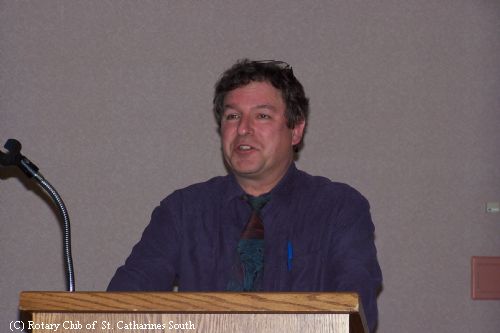
"Fifty-eight hundred people across Ontario are dying prematurely because of smog-related pollutants," notes Doug Draper.
Born and raised in Welland, Doug earned an Honours BA in Psychology from Brock University and a Masters of Arts degree in Journalism from the University of Western. Doug began his career with the St. Catharines Standard in 1979. He covered Niagara-on-the-Lake where the overwhelming concern of the town's residents was the toxic waste polluting the Niagara River from the Love Canal and other American dump sites upstream.
For the next 16 years, Doug worked full-time as the newspaper's environment reporter, receiving high praise for his work on both sides of the border. He received three "Distinguished Achievement" honours for his writing on the environment and other topics from the Western Ontario Newspaper Awards and, in 1993, the Lieutenant Governor of Ontario presented him with an award for "Outstanding Contribution by the Media," on behalf of the Federation of Ontario Naturalists, one of Canada's oldest and largest conservation organizations.
After leaving the Standard in 1998, Doug worked freelance, filing stories with the Hamilton Spectator, the Buffalo News, Pulse Niagara, and local magazines. He joined the staff of Thorold News, which has since become a Niagara This Week publication. Three years ago, Doug received an award for "Excellence in Environmental Writing" from the Canadian Community Newspaper Association as well as the annual award from the Niagara Region's Public Health Department for "Best Feature on a Health Issue by a Weekly Newspaper."
In April of 2004, Doug became a senior reporter for Niagara This Week. Earlier this year, Doug won Ontario and National newspaper awards for co-writing a series of articles on the Niagara Park's Commission ill-fated attempt to gondola ride into the gorge next to the Horseshoe Falls.
Doug is married to Nancy and has a daughter, Sarah.
Doug spoke to the Rotary Club of St. Catharines South a number of years ago about pollution in the Great Lakes.
Doug noted that, 20 years ago, when he was reporting on the Love Canal situation and addressed our membership, he was quite emotional about pollutants in the Great Lakes. He added that we have come a long way in addressing this issue. The level of dioxins in the Great Lakes has declined by 70 to 80 per cent.
"The Blue Box" has become a part of our lexicon. Pelham was the first community to embrace the Blue Box.
Air quality is now the problem, and it is smog concerns these days, which concerns Doug the most. As of November 3rd, 2005, there have been 53 days where smog advisories have been in effect. This is a record number of days in the last 10 years in our part of the world. And the public appears to be accepting this reality as background noise.
Fifty-eight hundred people across Ontario are dying prematurely because of smog-related pollutants. In Niagara, about 200 people have been affected. This is much larger than traffic fatalities or homicides in Niagara, and yet we are not reading about it in the local papers.
We can do something about smog-related pollutants. We can change the kinds of vehicles we drive. We can opt for smaller, more fuel-efficient vehicles. We can implement a region-wide transit system.
The global warming we are experiencing with the melting of our ice caps and the frequency and violence of storms does have something to do with the unsettling greenhouse effects.
It is possible that the United States will close its border to Toronto for the dumping of waste. Toronto has failed to put together a long-term recycling plan. If an emergency is declared, our landfill sites in Niagara could be declared full. We should not accommodate Toronto in this regard.
Questions were asked of Doug, such as whether the Kyoto Accord is the answer to global warming. Doug feels that it is a good framework. Our collective behaviour should do a lot to resolve issues - such as our transportation choices.
Doug noted that there are so many things we can do - as a society and as a country - to play a leadership role with respect to our environment.
President Bob thanked Doug for his informative talk, and Andrew Bowles presented Doug with a pen to continue writing powerful, persuasive, and behaviour-changing articles.
For the next 16 years, Doug worked full-time as the newspaper's environment reporter, receiving high praise for his work on both sides of the border. He received three "Distinguished Achievement" honours for his writing on the environment and other topics from the Western Ontario Newspaper Awards and, in 1993, the Lieutenant Governor of Ontario presented him with an award for "Outstanding Contribution by the Media," on behalf of the Federation of Ontario Naturalists, one of Canada's oldest and largest conservation organizations.
After leaving the Standard in 1998, Doug worked freelance, filing stories with the Hamilton Spectator, the Buffalo News, Pulse Niagara, and local magazines. He joined the staff of Thorold News, which has since become a Niagara This Week publication. Three years ago, Doug received an award for "Excellence in Environmental Writing" from the Canadian Community Newspaper Association as well as the annual award from the Niagara Region's Public Health Department for "Best Feature on a Health Issue by a Weekly Newspaper."
In April of 2004, Doug became a senior reporter for Niagara This Week. Earlier this year, Doug won Ontario and National newspaper awards for co-writing a series of articles on the Niagara Park's Commission ill-fated attempt to gondola ride into the gorge next to the Horseshoe Falls.
Doug is married to Nancy and has a daughter, Sarah.
Doug spoke to the Rotary Club of St. Catharines South a number of years ago about pollution in the Great Lakes.
Doug noted that, 20 years ago, when he was reporting on the Love Canal situation and addressed our membership, he was quite emotional about pollutants in the Great Lakes. He added that we have come a long way in addressing this issue. The level of dioxins in the Great Lakes has declined by 70 to 80 per cent.
"The Blue Box" has become a part of our lexicon. Pelham was the first community to embrace the Blue Box.
Air quality is now the problem, and it is smog concerns these days, which concerns Doug the most. As of November 3rd, 2005, there have been 53 days where smog advisories have been in effect. This is a record number of days in the last 10 years in our part of the world. And the public appears to be accepting this reality as background noise.
Fifty-eight hundred people across Ontario are dying prematurely because of smog-related pollutants. In Niagara, about 200 people have been affected. This is much larger than traffic fatalities or homicides in Niagara, and yet we are not reading about it in the local papers.
We can do something about smog-related pollutants. We can change the kinds of vehicles we drive. We can opt for smaller, more fuel-efficient vehicles. We can implement a region-wide transit system.
The global warming we are experiencing with the melting of our ice caps and the frequency and violence of storms does have something to do with the unsettling greenhouse effects.
It is possible that the United States will close its border to Toronto for the dumping of waste. Toronto has failed to put together a long-term recycling plan. If an emergency is declared, our landfill sites in Niagara could be declared full. We should not accommodate Toronto in this regard.
Questions were asked of Doug, such as whether the Kyoto Accord is the answer to global warming. Doug feels that it is a good framework. Our collective behaviour should do a lot to resolve issues - such as our transportation choices.
Doug noted that there are so many things we can do - as a society and as a country - to play a leadership role with respect to our environment.
President Bob thanked Doug for his informative talk, and Andrew Bowles presented Doug with a pen to continue writing powerful, persuasive, and behaviour-changing articles.